

In the past few years, educators have continually been challenged with the great distractors to education. First, COVID-19 and now Artificial Intelligence (AI). While we have overcome many of the setbacks and COVID-19 has become a part of the norm, AI feels like it presents a different set of challenges.
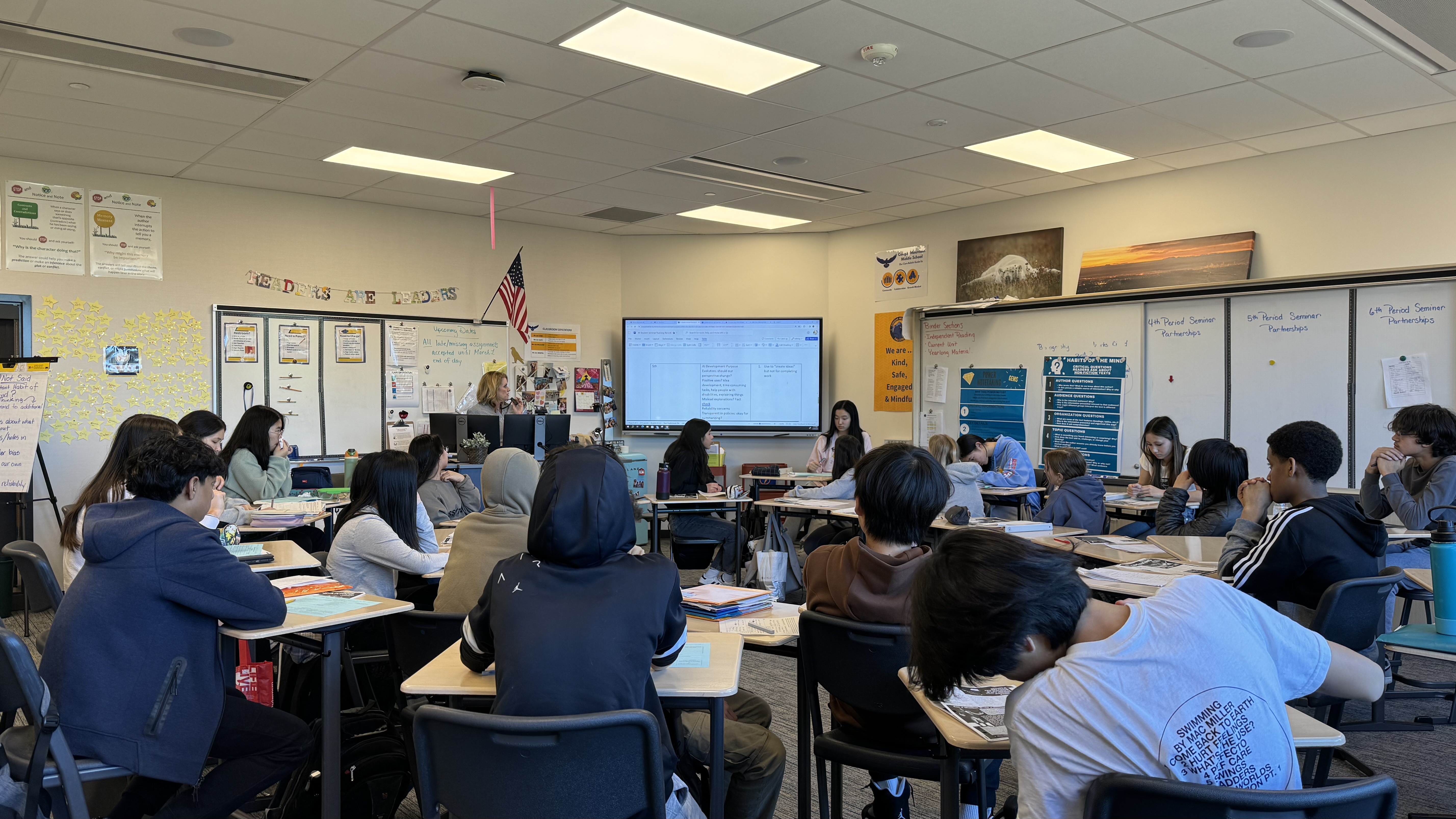
One way to address these challenges is by incorporating student voice in the discussion of how AI should be used in our classrooms. At Cougar Mountain Middle School, 8th grade Advanced Language Arts teacher Holly Stipe was inspired by two contradicting ads during the most recent Super Bowl. Microsoft Co-Pilot depicted AI as the future with a very positive outlook and the other used our favorite Minions to emphasize the haphazard nature of AI.
In education, many of us are living somewhere between these two opposing views of AI. Holly decided to spur the conversation about AI’s place in her class by sharing these opposing representations with the goal of developing guiding principles about the ethical use of AI in their ELA class. In addition to the ads, she provided students with an Upfront Magazine article “The Chatbot is Speaking” and with the option to find additional reliable resources. She structured the conversation using Socratic Seminar where an inside circle of students participate in the discussion and an outer circle of students serve as discussion coaches.

The conversation students had was invigorating and showcased how deeply our students are thinking about the uses of AI and the impact to education. Students enthusiastically embraced the Socratic Seminar protocols by inviting others to the conversation, proposing questions, and conferring with their coach.

While the Socratic Seminar was the process in which to initiate the discussion, Holly provided a platform for students to contribute to a Statement of Understanding which outlines expectations of how AI can be used in her classroom. Some of the key ideas that her students came up with include the following:
Artificial Intelligence tools can be helpful to start or review my schoolwork. However, passing the work of AI as one’s own original work is academically dishonest. Before using Artificial Intelligence apps to support schoolwork, students will check with the teacher to understand the appropriate use of AI for the assignment. The purpose of English class is the development of reading, writing, and thinking skills, and so using any device that prevents the development of an assignment’s purpose will be avoided. It is also understood that AI may provide inaccurate information about people, places, or facts. All care should be taken to ensure information gathered using AI is fact-checked
Holly Stipes 8th Grade Advanced ELA Students, CMMS
Holly strived to have her students become a part of the conversation and found that they are thinking critically about the future of AI and the impact on education. Ultimately, her class determined that AI could be used in her class for the following purposes:
- Research/Resources: searching for resources to aid the research of topics; care will be taken by the student to ensure source reliability and trustworthiness
- Idea Generation: asking questions as a brainstorming tool; students understand that brainstorming does not replace the writing process or idea and topic development; Student understands there’s a difference between prompting AI with queries such as, “What are some ideas to consider about….” vs. “Write an essay about….”
- Transparency is important above all else: when AI tools are used, they will be named, shared, and otherwise cited as directed by the teacher throughout the process of assignments and projects.
By providing students with the opportunity to engage in a topic that is prevalent in education, creating a structure that embraces critical thinking, and honoring her students as productive members of their classroom community, Holly now has a collaborative document that she and her students can refer to concerning the ethical use of AI in their classroom.
Students then wrote a feature article on a topic of their choice. Student, Jacob Park, chose to expand upon the topic of AI with his feature article “Evolution of AI: Advancement or Annihilation.” He was able to use many of the ideas presented during the Socratic Seminar and further expand with additional research.
If you would like to learn more about running a Socratic Seminar, start with this article Socratic Seminars: Building a Culture of Student-Led Discussion. If you are interested in learning more about engaging your students in the discussion around the use of AI, please consider taking our AI Canvas Course.